The Alishan Forest Railway was conceived during the Japanese colonial period in Taiwan. Initial surveys began in 1900, and construction commenced in 1906 to support the logging of valuable cypress and Taiwania trees in the Alishan region [1]. The terrain proved challenging, and the first contractor, Fujita-gumi, abandoned the project in 1908. The Japanese government resumed construction in 1910, completing the main line to Zhaoping by 1913 [1].
Originally built for timber transport, the railway played a crucial role in Japan’s exploitation of Taiwan’s forest resources. Shay locomotives were imported to handle the steep gradients and tight curves of the mountainous route[1]. In 1933, the line was extended to Niitakaguchi, near Mount Niitaka (now Yushan), to facilitate hiking tourism, marking the beginning of its dual role as a transport and recreational line [1].
After World War II and the end of Japanese rule, the railway continued operations under Taiwanese administration. Logging ceased in 1988, and the completion of the Alishan Highway in 1982 led to a decline in passenger numbers [2]. However, the railway’s scenic beauty and historical significance helped it transition into a tourist attraction, drawing visitors with its switchbacks, tunnels, and forest views [2].
The railway suffered extensive damage from natural disasters, including Typhoon Morakot in 2009 and Typhoon Dujuan in 2015, which led to partial closures [1]. Restoration efforts culminated in the full reopening of the main line in July 2024, following the completion of Tunnel No. 42 [1]. The Alishan Forest Railway and Cultural Heritage Office now oversees preservation, education, and sustainable tourism initiatives [3].
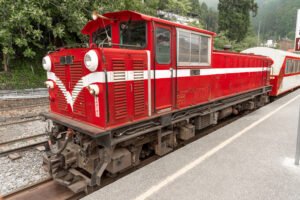
Today, the Alishan Forest Railway is recognized as a cultural treasure and a potential World Heritage Site [1]. It offers a unique journey through Taiwan’s diverse climate zones and forest ecosystems, from tropical lowlands to alpine peaks. The railway not only preserves Taiwan’s industrial heritage but also supports local economies and promotes eco-tourism [2].
This historical overview was generated using AI and is based on verified sources including Wikipedia[1], the Alishan Forest Railway and Cultural Heritage Office [3], and Foreigners in Taiwan [2].